
|
||
 |
Investment Trends |  |
|
||
 |
Cronus Capital Markets |  |
CCM SECTOROPTICS
WITH MICHAEL SONI
|
|
Michael Soni, is the President & CEO of Cronus Capital Markets
- an investment services firm specializing in sector-based research,
intelligence, and media. CCM transforms “Top-Down” research into
intelligence by identifying sectors within the capital markets that,
in addition to their inherent strengths, will benefit from participation
in larger trends and cycles.
|

Please give us an overview of the biometrics market, today and going into the future.
Biometrics involves the use of human identifiers to recognize a person and related personal information/data based on physiological or behavioral characteristics. Biometric features include identifiers such as a person’s facial features, fingerprints/hand geometry, retina/iris scans, and handwriting or voice characteristics.
According to the International Biometrics Group (IBG), the biometric market was estimated at $1.2 billion in 2004 and is expected to be one of the fastest developing sectors, growing by approximately 40% annually to an estimated $4.6 billion by 2008. Of the 2004 total, IBG estimates that fingerprint technology represented nearly half (48%) of the market, followed by face recognition technologies (12%), hand identification (11%), iris technologies (9%), voice recognition (6%) and numerous other technologies.
1) Enhanced Border Security and Visa Reform Act of 2001, passed shortly after 9/11
2) US-VISIT program with an estimated $400 million budget.
3) The Office of Legislative Counsel, which is the legislative drafting service of the U.S. House of Representatives, has begun deploying biometric authentication software on its computers.
4) U.S. Department of Defense will utilize 600,000 smart cards as part of the Common Access Card program, to be rolled out at 900 sites. The smart cards will be used for personnel identification, electronic signatures, e-commerce, and secure building and system access, and will eventually support more than four million cardholders.
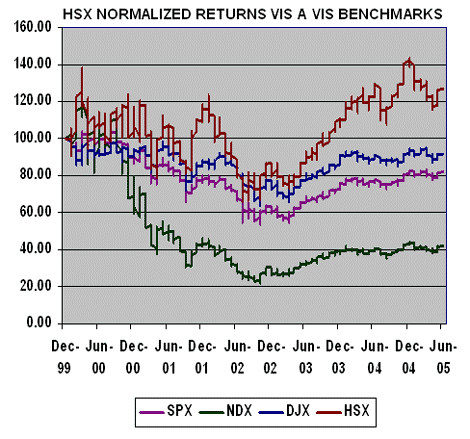
Which companies in the HSX Index will benefit from biometrics industry growth?
Identix (IDNX– NASDAQ),
ActivCard (ACTI – NASDAQ)
Viisage Corp (VISG – NASDAQ)
A non-HSX play is;
Cogent Systems (COGT – NASDAQ).
RFID involves technologies used to identify and track goods using both a reader and ‘smart tag’, or tiny microchip attached to an asset. The technology is similar to bar codes in that information is read; however, bar codes have to be physically ‘scanned’ while radio waves are sent by RFID tags that are read by a passive RF transmitter and receiver. The technology also involves software that links the relationship between reader and smart tag. RFID will prove to have many applications and sophistication, improving inventory management and allowing firms to more aggressively drive sales growth or governments to enhance security.
As with a large number of burgeoning technologies that receive initial funding via public security initiatives (such as global positioning systems (GPS); even RFID dates back to WWII as a radar system), the federal government has accelerated RFID research and development as it pursues better ways to track shipping container cargo, reduce counterfeiting, and improve military supply chain management primarily as a result of September 11.
However, RFID is receiving considerable private sector attention as witnessed by Wal-Mart which demanded that its top 100 suppliers utilize RFID for certain shipments. The demand-pull has been primarily retail driven; other firms with RFID mandates include Target, Albertson’s, and British-based retailer Tesco. Indeed, International Data Corp (IDC) estimates that the RFID marketplace for U.S retail chain spending stood at $91.5 million for full year 2003 and projects the market to grow exponentially to over $1.3 billion by 2008.
These include:
Infosys (INFY – NASDAQ)
Zebra Technologies (ZBRA– NASDAQ)
Symbol Technologies (SBL– NYSE)
I.D. Systems (IDSY – NASDAQ).
>>CCM Sector Optics Archive
Disclaimer
Michael Soni, is President & CEO of Cronus Capital Markets- a firm
specializing in sector research, intelligence, and media. At the time
of publication, he had no positions in any of the securities mentioned
in this column, but holdings can change at any time. CCM transforms “Top-Down”
research into intelligence by identifying sectors within the capital markets
that, in addition to their inherent strengths, will benefit from participation
in larger trends and cycles.
CCM enhances SectorOptics, by deconstructing and filtering the capital
markets, in order to identify sectors experiencing a higher frequency
of opportunities. By enhancing SectorOptics, CCM focuses the lens with
which capital market sectors are viewed, resulting in greater clarity.
Under no circumstances does the information in this commentary represent
a recommendation to buy or sell stocks. While he cannot provide investment
advice or recommendations, he invites you to send your feedback –
click here
to send him an email.
Please see SecuritySolutionsWatch.com Terms
of Use and Disclaimer.