
|
||
 |
Investment Trends |  |
|
||
 |
Cronus Capital Markets |  |
CCM SECTOROPTICS
WITH MICHAEL SONI
|
|
Michael Soni, is the President & CEO of Cronus Capital Markets
- an investment services firm specializing in sector-based research,
intelligence, and media. CCM transforms “Top-Down” research into
intelligence by identifying sectors within the capital markets that,
in addition to their inherent strengths, will benefit from participation
in larger trends and cycles.
|

SecuritySolutionsWatch.com
How has the ISE-CCM Homeland Security Index (ISE:HSX) performed since the London attack?
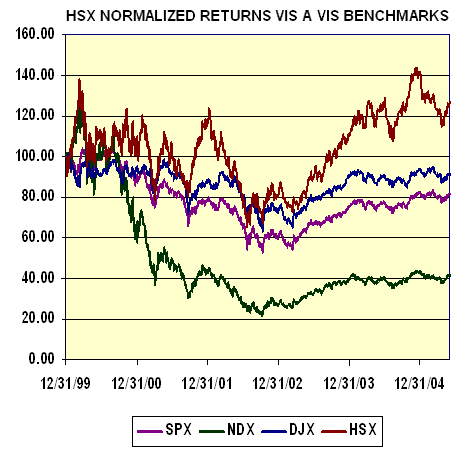
HSX was developed in collaboration with the International Securities Exchange (ISE) in NYC, and both the ISE and CCM intended for the index to be used dually as an insurance mechanism against terrorism warnings/attacks, and as a way to measure the growth of the Homeland Security industry.
Now having said that, there a number of things that can be done. Below, I will list potential actions that can be taken and which companies in HSX would benefit should any of these actions be implemented. HSX represents the most liquid companies relating to the 6 Homeland Security missions, (1. Intelligence and Warning, 2. Border and Transportation Security, 3. Domestic Counterterrorism, 4. Protection of Critical Infrastructure and Key Assets, 5. Defense Against Catastrophic Threats, 6. Emergency Preparedness and Response) therefore I will use the 30 stocks as my universe when linking companies to potential actions.
First and foremost, intelligence gathering and domestic counterterrorism must be more effective to stop attacks similar to what happened in London. The goal is to stop attacks before they happen. One could predict that funds will continue to flow, in an ever increasing fashion, to strategies that concern themselves with various types of surveillance, both electronic and physical.
The most difficult and dangerous aspect of terrorism is the intelligence gathering that terrorists perform before an attack. It is here that the probability of detection by the authorities is highest. As the attack becomes nearer the terrorist agents go quiet, or as they say in intelligence circles, they go “dark”. Just prior to this ‘Dark” period is the window where an attack can be stopped.
Companies in HSX that are involved with intelligence gathering and domestic counterterrorism are as follows;
L-3 Communications (NYSE:LLL)
FLIR Systems (NASDAQ:FLIR)
Titan Corp (NYSE:TTN)
CACI International (NYSE:CAI)
Anteon International (NYSE:ANT)
Mantech International (NASDAQ:MANT)
Verint Systems (NASDAQ:VRNT)
Applied Signal Technology (NASDAQ:APSG)
2) Detection technology seems to be a non-intrusive way for the authorities to ascertain if passengers have come into contact with various hazardous materials which can be used in a terrorist attack. Now, of course there is the possibility of false negatives but I would think that it is better to be safe than sorry. I believe that this is one of the better potential solutions due to the fact that the technology is only looking for specific materials, and assuming no adverse effects to humans, it would maintain the critical aspects of the mass transit system which make it efficient to use.
Companies in HSX that are involved with detection technology are as follows;
OSI Systems (NASDAQ:OSIS)
RAE Systems (AMEX:RAE)
3) Another possibility, although much more difficult to implement due to cost, timeline, database security and potentially for reasons pertaining to civil liberties, is the national ID card system utilizing biometrics technology. This strategy deals more with the aftermath of an attack as it relates to tracking the movements of high risk individuals in order to apprehend, interrogate, and prosecute.
Companies in HSX who are involved with ID cards and biometrics technology are as follows;
Identix (NASDAQ:IDNX)
Zebra Technologies (NASDAQ:ZBRA)
Viisage Technology (NASDAQ:VISG)
ActivCard Corp (NASDAQ:ACTI)
Phishing as defined by the Anti-Phishing Working Group is as follows;
Phishing attacks use both social engineering and technical subterfuge to steal consumers' personal identity data and financial account credentials. Social-engineering schemes use 'spoofed' e-mails to lead consumers to counterfeit websites designed to trick recipients into divulging financial data such as credit card numbers, account usernames, passwords and social security numbers. Hijacking brand names of banks, e-retailers and credit card companies, phishers often convince recipients to respond. Technical subterfuge schemes plant crimeware onto PCs to steal credentials directly, often using Trojan keylogger spyware. Pharming crimeware misdirects users to fraudulent sites or proxy servers, typically through DNS hijacking or poisoning.
The final technical solution to phishing involves significant infrastructure changes in the Internet that are beyond the ability of any one institution to deploy. However, there are steps that can be taken now to reduce the consumer’s vulnerability to phishing attacks. McAfee recommends the following steps:
For Corporations:
- • Establish corporate policies and communicate them to consumers.
• Provide a way for the consumer to validate that the E-mail is legitimate.
• Stronger authentication at web sites.
• Monitor the Internet for potential phishing web sites.
• Implement good quality anti-virus, content filtering and anti-spam solutions at the Internet gateway.
For Consumers:
- • Automatically block malicious/fraudulent E-mail.
• Automatically detect and delete malicious software.
• Automatically block outgoing delivery of sensitive information to malicious parties.
• Be suspicious.
All of these technologies are available now and can be deployed by both consumers and
institutions interested in protecting their customers.
Companies in HSX who are involved with network security are as follows;
McAfee Inc. (NYSE:MFE)
RSA Security (NASDAQ:RSAS)
ActivCard Corp (NASDAQ:ACTI)
Internet Security Systems (NASDAQ:ISSX)
Check Point Software (NASDAQ:CHKP)
>>CCM Sector Optics Archive
Disclaimer
Michael Soni, is President & CEO of Cronus Capital Markets- a firm specializing in sector research, intelligence, and media. At the time of publication, he had no positions in any of the securities mentioned in this column, but holdings can change at any time. CCM transforms “Top-Down” research into intelligence by identifying sectors within the capital markets that, in addition to their inherent strengths, will benefit from participation in larger trends and cycles.
CCM enhances SectorOptics, by deconstructing and filtering the capital markets, in order to identify sectors experiencing a higher frequency of opportunities. By enhancing SectorOptics, CCM focuses the lens with which capital market sectors are viewed, resulting in greater clarity.
Under no circumstances does the information in this commentary represent a recommendation to buy or sell stocks. While he cannot provide investment advice or recommendations, he invites you to send your feedback – click here to send him an email.
Please see SecuritySolutionsWatch.com Terms of Use and Disclaimer.